
Minecraft Low Poly Models
Minecraft low poly modeling is different from generic game low poly: the visual language is cube-based, texture pixels are part of the style, and the final asset must respect Java or Bedrock model rules rather than free-form mesh assumptions.
Matching downloadable assets
Start with these seed models, then generate variants in the same low-poly direction.
Members unlock protected STL access
Use the free OBJ to test the shape. Subscribe for protected STL downloads now; GLB, FBX, USDZ and Unity are shown as production export targets, not direct library downloads yet.
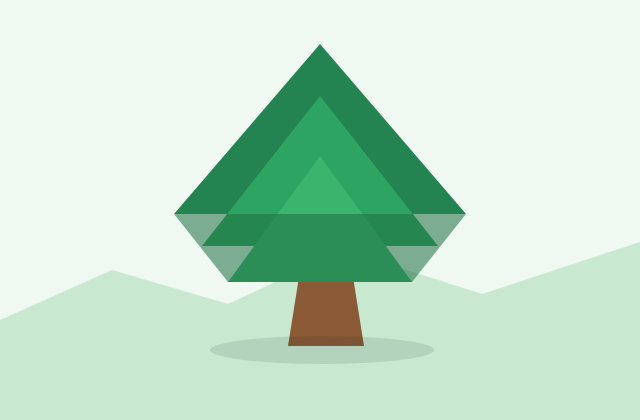
Nature Starter Pack
Low-Poly Pine Tree
A lightweight forest prop with a trunk, two faceted foliage layers and a clean base pivot for scattering.
View details- Triangles
- 24
- Texture
- Flat color
- License
- Commercial use
- Formats
- OBJ
Protected STL download
Production export targets
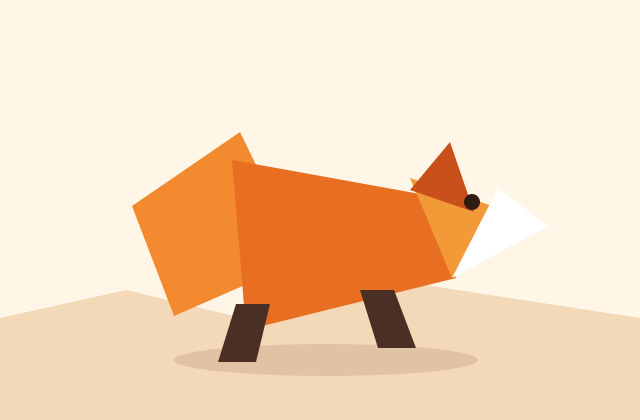
Cozy Animal Pack
Low-Poly Fox
A stylized animal prop for cozy games, woodland scenes and AR previews.
View details- Triangles
- 24
- Texture
- Flat color
- License
- Commercial use
- Formats
- OBJ
Protected STL download
Production export targets
Highlights
- Minecraft-style modeling is cuboid-based, not arbitrary triangle-mesh first
- Blockbench is the practical authoring bridge for Java and Bedrock models
- Java block/item models use JSON elements, faces, rotations and texture references
- Bedrock entity models use a separate geometry, bone and animation system
- Textures commonly use 16x16, 32x32 or 64x64 pixel-art scales
- Snap UVs to pixel boundaries to avoid blurry texture bleeding
- Stay close to the 16-unit block grid for Java block and item models
- Test in the exact Java or Bedrock version because pack rules differ
The core modeling unit is the cuboid, not an arbitrary triangle mesh. In Blockbench and Minecraft resource packs, most models are built from boxes with per-face UVs, pivots for bones or item transforms, and tiny pixel textures that usually live at 16x16, 32x32 or 64x64 scale. A model that looks low poly in Blender may not be a good Minecraft asset if it relies on diagonal free-form silhouettes, high-resolution gradients or PBR materials that the target pack format does not support.
Java Edition item and block models use JSON structures with elements, faces, rotations and texture references, while Bedrock entity models use a different geometry and animation system. That distinction matters before modeling begins. Java block/item assets should stay close to the 16-unit block grid and use rotations sparingly, while Bedrock entities can use bones, pivots and animations more naturally. Exporting a generic GLB is not enough; the model often needs to be authored or converted through Blockbench into the correct pack structure.
Texture strategy is intentionally pixel-limited. A 16x16 or 32x32 palette can be more authentic than a smooth 1024px texture, and UVs should snap cleanly to pixel boundaries to avoid blurry bleeding. Keep color regions readable from normal gameplay distance, avoid semi-transparent layers unless the pack target supports them, and remember that Minecraft lighting and shader packs can alter the final look. For entities, simple cubes with strong silhouette beats dense bevels that disappear in first-person gameplay.
Performance constraints are different from a WebGL GLB scene but still real. Hundreds of custom entities or item models can add render cost, especially if they use many cuboids, transparency or animations. Keep small item models to a handful of elements, keep entity bones purposeful, and test in the actual Java or Bedrock version you target. Minecraft-style low poly works best when it embraces the block grid instead of fighting it.
Related style and modeling pages
Frequently asked questions
Can I use any low poly mesh in Minecraft?
Not directly. Minecraft resource packs expect specific Java or Bedrock model structures, often authored through Blockbench rather than imported as a generic mesh.
Should Minecraft low poly models use GLB?
GLB can be useful as an interchange or preview format, but the final pack usually needs Java JSON or Bedrock geometry files.
What texture size should I use?
Use pixel-art scales such as 16x16, 32x32 or 64x64 unless the pack intentionally targets higher resolution. Sharp pixels are part of the style.
Why does my texture look blurry?
UVs may not align to pixel boundaries, or filtering/mipmap settings may be smoothing the texture. Snap UVs and check pack settings.
Are Java and Bedrock models interchangeable?
No. They use different model, animation and pack structures. Decide the target edition before building the asset.
Related
Browse allNeed a custom low-poly model?
Generate one from a text prompt or reference image, then export GLB, FBX, OBJ or STL.
Open the generator