
Low Poly Crystal 3D Model
A crystal is one of the few low poly props where the material does more work than the geometry, since its faceted angular shape is genuinely how real crystals grow, but making it read as glass or gem rather than solid stone depends entirely on getting transparency and glow right in the engine.
Matching downloadable assets
Start with these seed models, then generate variants in the same low-poly direction.
Members unlock protected STL access
Use the free OBJ to test the shape. Subscribe for protected STL downloads now; GLB, FBX, USDZ and Unity are shown as production export targets, not direct library downloads yet.

Nature Starter Pack
Low-Poly Pine Tree
A lightweight forest prop with a trunk, two faceted foliage layers and a clean base pivot for scattering.
View details- Triangles
- 24
- Texture
- Flat color
- License
- Commercial use
- Formats
- OBJ
Protected STL download
Production export targets
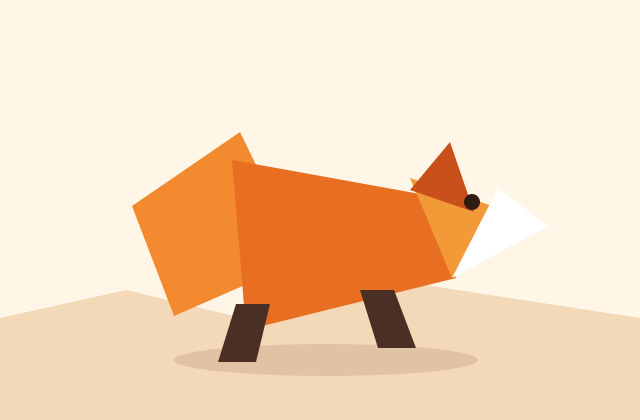
Cozy Animal Pack
Low-Poly Fox
A stylized animal prop for cozy games, woodland scenes and AR previews.
View details- Triangles
- 24
- Texture
- Flat color
- License
- Commercial use
- Formats
- OBJ
Protected STL download
Production export targets
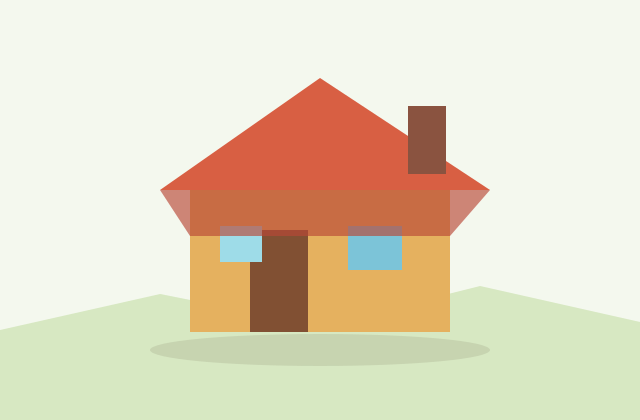
Village Starter Pack
Low-Poly Cottage House
A compact village building for cozy sims, isometric towns and stylized environment blocking.
View details- Triangles
- 18
- Texture
- Flat color
- License
- Commercial use
- Formats
- OBJ
Protected STL download
Production export targets
Highlights
- Scatter shard: 60-200 triangles; hero cluster: 400-1,200; environmental centerpiece: 2,000-4,000
- Real crystal faces are large and few — resist smoothing or subdividing past a handful of facets
- Disable backface culling (double-sided material) so the interior reads through translucent facets
- Double-sided transparency roughly doubles overdraw cost vs. an opaque prop of the same triangle count
- Emissive core plus a Fresnel/rim-light effect sells the faceted gem look better than flat transparency alone
- A small low-intensity point light adds a believable glow cast for hero props only
- Keep every crystal variant on one shared translucent + emissive material, not a unique material per crystal
- Vary color via tint parameter or vertex color, never separate textures per crystal
A single scatter-prop crystal shard reads clearly at 60 to 200 triangles, since a handful of large angled facets is both geologically accurate and cheap. A hero crystal cluster, several shards growing from a shared base, typically runs 400 to 1,200 triangles, and a giant environmental centerpiece, a crystal cave wall or a quest-relevant obelisk, can reasonably reach 2,000 to 4,000. Unlike most props, more facets rarely help a crystal read better past a certain point, since real crystal faces are large and few, so resist the urge to smooth or subdivide the surface.
The detail most beginners miss is that a translucent crystal genuinely needs double-sided rendering, disabling backface culling in the material, because a player looking through one facet will see the interior back faces of the far side of the mesh; with normal single-sided culling those back faces simply vanish and the crystal reads as a hollow, broken shell instead of a solid gem. This doubles the crystal's effective overdraw cost compared to an opaque prop of the same triangle count, which is exactly why crystals should stay small and few in number in any one view rather than filling a whole cave wall with one continuous transparent mesh.
Glow is a material property, not geometry: bake or drive an emissive channel at the crystal's core so it reads as lit from within, and pair it with a simple Fresnel or rim-light effect on the same material so the facet edges catch a brighter highlight than the flat faces, which sells the faceted, gem-like read far better than a single flat transparent color. A soft point light placed at the crystal's center, set to a small radius and low intensity, adds a believable glow cast onto nearby surfaces for a genuine hero prop, though a purely emissive material alone is enough for scattered background crystals where a real light per instance would be wasteful.
Because transparency and emissive materials do not batch as cheaply as a single opaque flat-color material, keep every crystal in a scene, regardless of color variant, on one shared translucent material and a small emissive-gradient atlas rather than a unique material per crystal, and scatter color variation through a tint parameter or vertex color rather than separate textures. A cave wall of a hundred crystal shards should still resolve to one or two materials total, not a hundred unique ones.
Low poly crystals populate fantasy cave and mine environments, magic quest-item props, sci-fi power-source set dressing, and collectible currency or mana-pickup icons. Export GLB for Godot, the web and Three.js where transparency and emissive channels are both well supported, or FBX for Unity and Unreal to carry the same material setup into a URP or Lumen-lit scene. Everything generated here is yours to use commercially with no attribution required, so a crystal cluster you generate can headline a shipped fantasy RPG or a paid environment pack. Generate one cluster you like, then request color and size variants so a whole crystal cave reads as a deliberate, varied deposit rather than one shard repeated.
Build the cave scene
Frequently asked questions
How many triangles should a low poly crystal be?
A scatter-prop shard reads clearly at 60-200 triangles. A hero cluster of several shards typically runs 400-1,200, and a giant environmental centerpiece can reasonably reach 2,000-4,000.
Why does my crystal look hollow or broken?
The material almost certainly has backface culling enabled. A translucent crystal needs double-sided rendering so the interior back faces of the far side of the mesh are visible when looking through a near facet, or it reads as a hollow shell instead of a solid gem.
How do I make a crystal glow?
Bake or drive an emissive channel at the core rather than relying on a real light for every instance, and add a Fresnel or rim-light effect so facet edges catch a brighter highlight. Reserve an actual small point light for hero props only, since crystals are already expensive due to double-sided transparency.
Why is a cave full of crystals expensive to render?
Double-sided transparent materials roughly double overdraw compared to an opaque prop of the same triangle count. Keep every crystal on one shared material and vary color with a tint parameter or vertex color instead of unique materials per shard.
Can I use a generated crystal in a commercial game?
Yes. Generated crystal models are yours to use commercially with no attribution required, including in a shipped fantasy RPG or a paid environment asset pack.
Related
Browse allNeed a custom low-poly model?
Generate one from a text prompt or reference image, then export GLB, FBX, OBJ or STL.
Open the generator