
Low Poly Shield 3D Model
A shield is not just a flat badge on a character arm. It needs thickness, a readable rim, a believable hand grip on the back and a pivot that lines up with animation sockets.
Matching downloadable assets
Start with these seed models, then generate variants in the same low-poly direction.
Members unlock protected STL access
Use the free OBJ to test the shape. Subscribe for protected STL downloads now; GLB, FBX, USDZ and Unity are shown as production export targets, not direct library downloads yet.

Nature Starter Pack
Low-Poly Pine Tree
A lightweight forest prop with a trunk, two faceted foliage layers and a clean base pivot for scattering.
View details- Triangles
- 24
- Texture
- Flat color
- License
- Commercial use
- Formats
- OBJ
Protected STL download
Production export targets
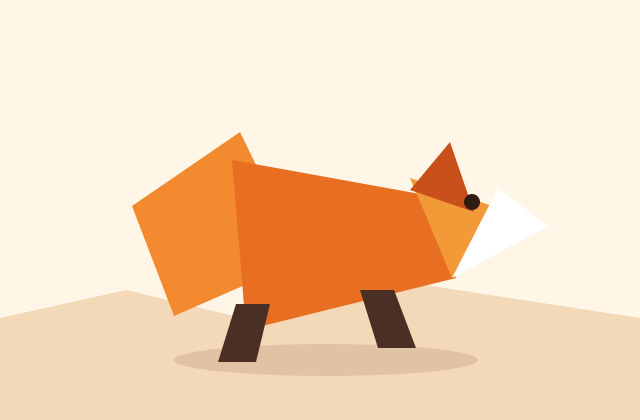
Cozy Animal Pack
Low-Poly Fox
A stylized animal prop for cozy games, woodland scenes and AR previews.
View details- Triangles
- 24
- Texture
- Flat color
- License
- Commercial use
- Formats
- OBJ
Protected STL download
Production export targets
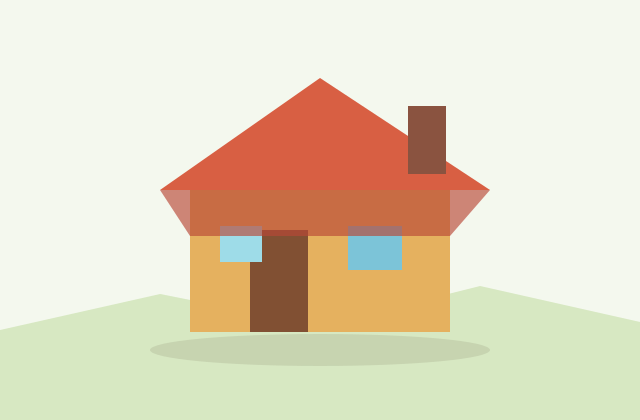
Village Starter Pack
Low-Poly Cottage House
A compact village building for cozy sims, isometric towns and stylized environment blocking.
View details- Triangles
- 18
- Texture
- Flat color
- License
- Commercial use
- Formats
- OBJ
Protected STL download
Production export targets
Highlights
- Basic pickup shield: 150-350 triangles
- Equipped mobile/WebGL shield: 500-1,200 triangles
- Desktop hero shield: 2,000-5,000 triangles with raised heraldry
- Model back straps because third-person cameras see the inside during blocks
- Attachment node belongs at the grip center, not the shield face center
- Hit detection should use one oversized convex collider for stable melee/projectile tests
- Use a front decal area for customizable emblems without extra materials
- Printable shields need about 2mm thickness and raised relief details
A basic mobile shield pickup can be 150 to 350 triangles with a beveled face, metal rim and simple back strap. A character-equipped shield for mobile or WebGL usually sits between 500 and 1,200 triangles because both the front and the back may be visible in animation. A desktop hero shield can use 2,000 to 5,000 triangles for raised heraldry, layered planks, dents and a sculpted boss. If the shield appears only as a UI inventory icon, keep the mesh cheap and spend more effort on the front silhouette and emblem color.
The shield-specific technical detail is back-side construction. A convincing shield needs a hand grip or forearm strap modeled on the back, even if it is low detail, because third-person cameras often catch the inside during run, block and equip animations. Put a small attachment empty or named node at the grip center, not the geometric center of the shield, so the character hand socket aligns naturally. If the pivot remains at the center of the front face, blocking poses often float away from the forearm.
Collision should be gameplay-driven. A decorative shield on a wall only needs a simple box. A carried shield used for hit detection should use a single slightly oversized convex collider that covers the visual face, not per-rim collision pieces, because fast melee traces and projectiles need stable, predictable results. For physics pickups, center mass slightly behind the front face so the shield falls with a believable weighted rim rather than tumbling like a flat card.
Materials can carry most of the style. Use one atlas for wood grain bands, metal rim, leather straps and painted heraldry; avoid separate materials for every emblem color. If players customize emblems, reserve a square decal area on the front face and keep the base shield material unchanged. For 3D printing, make the shield at least 2mm thick at tabletop miniature scale and raise heraldry as shallow relief instead of relying on color.
Low poly shields belong in fantasy RPGs, knight characters, wall decorations, loot drops, tabletop miniatures and AR costume previews. Export FBX for Unity and Unreal character sockets, GLB for Godot and web viewers, or STL/3MF for fused printable shields. Generated shield models are yours for commercial use with no attribution required.
Equip the character
Frequently asked questions
How many triangles should a low poly shield use?
A basic pickup can be 150-350 triangles. An equipped shield usually needs 500-1,200, and a desktop hero shield with raised details can use 2,000-5,000.
Does the back of a shield need detail?
Yes for character equipment. Third-person cameras often show the inside during run, equip and block animations, so model a simple grip or forearm strap.
Where should the attachment point be?
Place a named attachment node at the grip center on the back. That aligns with the character hand socket better than a pivot at the geometric face center.
What collider should a shield use?
For gameplay blocking, use one slightly oversized convex collider over the shield face. It is more stable for melee and projectile checks than many tiny rim colliders.
Can generated shield models be commercial?
Yes. Generated shields are yours to use in commercial games, tabletop prints, AR previews and asset packs with no attribution required.
Related
Browse allNeed a custom low-poly model?
Generate one from a text prompt or reference image, then export GLB, FBX, OBJ or STL.
Open the generator